IPv6 is big and complex in comparison with IPv4. This fact alone will keep users from implementation if they have any choice in the matter. Nevertheless, the internet is rapidly approaching the time - primarily due to IPv4 address depletion - when there is little choice but to move to IPv6. The transition will be accompanied by much yelling, screaming, gnashing of teeth and grim resignation. It is not helped by the constant roll-back and fiddling with the IPv6 specifications.
First things first. Each PC - more properly each network interface - may have more than one IPv6 address - IPv6 is naturally multi-homed. Second, an IPv6 address has a scope, that is, it can be restricted to a single LAN or a private network or be globally unique. The following table defines the types of IPv6 addresses that can be supported and contrasts them with their closest IPv4 functional equivalent.
An IPv6 address consists of 128 bits - an IPv4 address consists of 32 bits - and is written as a series of 8 hexadecimal strings separated by colons. (Format defined by RFC 4291 and updated by RFC 5952) Examples:
One or more zeros entries can be omitted entirely but only once in an address. The user can choose the most efficient place to omit multiple zero entries. Examples:
Multiple zeros can be omitted entirely but only once in an address. Examples:
IPv6 uses a similar / (forward slash) notation to IPv4 CIDR (Classless Interdomain Routing) which describes the number of contiguous bits used in its netmask. Formally this way of writing an address is called an IP prefix but more commonly called the slash format. Examples:
The type of IP address is defined by a variable number of the top bits known as the binary prefix (BP). Only as many bits as required are used to identify the address type as shown in the following table (defined in RFC 4291):
The revised definition is a conceptual change and is both more flexible than the previous (RFC 2373/RFC 3513) definition if a tad confusing. IPv4 and NSAP prefixes are still allowed for but are now simply unicast addresses. Subsequent changes (from RFC 3513 to RFC 4291) seem to be trying to remove some of the restrictions previously imposed such that RFCs now use the distinction between a binary prefix of 000 (covering IPv6 mapped IPv4, unassigned and loopback) and not 000 (all other unicast) rather than explicity using 001 as previously. The obsolescence of address block assignment from the previous binary prefix 001 seems to be of a theoretical nature since all current IANA address block assigments are still from this prefix.
The current IPv6 address allocation policy adopted by the various Regional Internet Registries should be based on the IETF/IAB recomendation (in RFC 3177) which allows for:
The justification for this, seemingly generous, address allocation policy is that the 45 address bits (48 bit global routing prefix - 3 bit binary prefix) still allow ~35 trillion /48 allocations (contrasted with the earth's population prediction of a mere 9 billion by 2050).
IPv6 systems may be configured to provide global unicast addresses using Stateless Address AutoConfiguation (SLAAC - defined by RFC 4862) using what is called generically the Neighborhood Discovery Protocol (NDP). Stateless autoconfiguration requires a router to be present but not a DHCP server. The process of creating a stateless IPv6 address is as follows:
Link-Local addresses are automatically assigned by the end user equipment and require no external configuration. Format defined by RFC 4291 Section 2.5.6. The address format uses a unique binary prefix (FE8::/10) and the remaining bits (118) are built from the local interface identifier. In the case of ethernet (RFC 2464) the MAC (48 bits) is used to create the EUI-64 value as shown below. Each physical layer supported has a separate RFC for example, FDDI, IEEE 802.15.4 etc. defining, among other things, how the link-local address is created. If an interface identifier has more than 118 bits the link-local address cannot be generated and the unit must be manually configured. Link-local addresses are not routable globally (outside the local LAN/network - however that is defined). The 128 bits of a link-local address for an ethernet interface breakdown as follows:
IPv6 allows transport of IPv4 addresses using two methods. The methods are described in RFC 2893/RFC 4038 and RFC 4291 Section 2.5.5.
The first method is termed an "IPv4-compatible IPv6 address" and must use a globally unique IPv4 address. Please note: To avoid publication of a global IPv4 the example below shows a private (non-globally unique) IPv4 address purely to illustrate the principle:
The IPv4-compatible IPv6 address format is used when the end interface supports both IPv6 and IPv4 (a dual stack interface). This method is now deprecated (RFC 4291).
The second method is termed an "IPv4-mapped IPv6 address" and must use a globally unique IPv4 address. Please note: To avoid publication of a global IPv4 the example below shows a private (non-globally unique) IPv4 address purely to illustrate the principle:
The IPv4-mapped IPv6 address format is used when the end interface supports only IPv4 and indicates that a configured IPv6 system, for instance, a router or the IPv6 stack will have to perform conversion to the IPv4 protocol prior to communicating with the interface.
IPv6 over IPv4 (more commonly refered to these days as 6to4) allows two IPv6 networks/devices to communicate over an IPv4 network (defined by RFC 3056). Both ends of the network must have a globally unique IPv4 address and the end points must run either a 6to4 relay or a 6to4 transit service. A special unicast address block has been assigned for these classes of service (2002::/16). The IPv6 address format used by this address block is defined below
The low order 80 bits allow for end user transparency within the IPv6 address. The relay or transit service will extract the IPv4 address when communicating accross the IPv4 cloud.
Alternatively, enter a single IPv6 address (that lies anywhere in the desired range) without the /prefix in IPv6/Prefix and the number of desired IP addresses (if it is not a power of 2 it will be rounded up to the nearest power of 2 - a maximum of 6 digits is allowed) in No. of IPs then click IPv6 Info. The calculator will populate IPv6/Prefix (with the calculated /Prefix to cover the required or calculated number of IP addresses), No. of IPs will be updated if needed (due to any power of 2 rounding required) and IPv6 Netmask, IPv6 GPR, IPv6 User:, Reverse Zone and In Zone IPv6: will be populated normally.
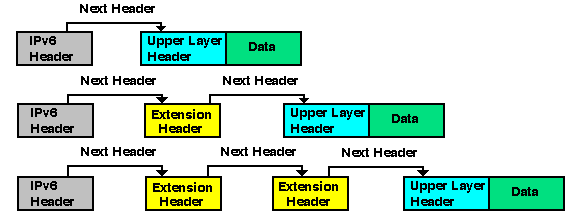
IPv6 headers are daisy chained. The Next Header field - present in every header except the upper layer header - indicates which header comes next as shown in the diagram below:
Where multiple headers are present the recommended sender order is (but the receiver must accept in any order):
Extension headers are always multiples of 8 octets. To allow skipping and processing of extension headers they all begin with the following 16 bit stub format:
The Hop-By-Hop and Destination Headers carry a variable number of options within the header and use a classic TLD (or TLV in the standards paralance) format as shown below:
In order to force so-called natural alignment of option fields two padding options are provided. An Option Type of 0 indicates a 1 octet pad (and does not have associated length or data fields), a standard Option with a Type of 1 allows for multiple octet padding. NB in this case a 2 octet pad will have an Option Length of 0.
This rather daunting list of RFCs describe IPv6 or are relevant to it. Many of the later RFCs simply roll-back features of the earlier ones. Most of the new work is associated with mobile development and various tunneling methods.
| RFC |
Description/Status |
| RFC 1809 |
Using the Flow Label Field in IPv6. C. Partridge. June 1995. (Format: TXT=13591 bytes) (Status: INFORMATIONAL) |
| RFC 1881 |
IPv6 Address Allocation Management. IAB, IESG. December 1995. (Format: TXT=3215 bytes) (Status: INFORMATIONAL) |
| RFC 1883 |
Internet Protocol, Version 6 (IPv6) Specification. S. Deering, R. Hinden. December 1995. (Format: TXT=82089 bytes) (Obsoleted by RFC2460) (Status: PROPOSED STANDARD) |
| RFC 1885 |
Internet Control Message Protocol (ICMPv6) for the Internet Protocol Version 6 (IPv6). A. Conta, S. Deering. December 1995. (Format: TXT=32214 bytes) (Obsoleted by RFC2463) (Status: PROPOSED STANDARD) |
| RFC 1887 |
An Architecture for IPv6 Unicast Address Allocation. Y. Rekhter, T. Li, Eds.. December 1995. (Format: TXT=66066 bytes) (Status: INFORMATIONAL) |
| RFC 1888 |
OSI NSAPs and IPv6. J. Bound, B. Carpenter, D. Harrington, J. Houldsworth, A. Lloyd. August 1996. (Format: TXT=36469 bytes) (Status: EXPERIMENTAL) |
| RFC 1924 |
A Compact Representation of IPv6 Addresses. R. Elz. Apr-01-1996. (Format: TXT=10409 bytes) (Status: INFORMATIONAL) |
| RFC 1932 |
IP over ATM: A Framework Document. R. Cole, D. Shur, C. Villamizar. April 1996. (Format: TXT=68031 bytes) (Status: INFORMATIONAL) |
| RFC 2080 |
RIPng for IPv6. G. Malkin, R. Minnear. January 1997. (Format: TXT=47534 bytes) (Status: PROPOSED STANDARD) |
| RFC 2375 |
IPv6 Multicast Address Assignments. R. Hinden, S. Deering. July 1998. (Format: TXT=14356 bytes) (Status: INFORMATIONAL) |
| RFC 2428 |
FTP Extensions for IPv6 and NATs. M. Allman, S. Ostermann, C. Metz. September 1998. (Format: TXT=16028 bytes) (Status: PROPOSED STANDARD) |
| RFC 2460 |
Internet Protocol, Version 6 (IPv6) Specification. S. Deering, R. Hinden. December 1998. (Format: TXT=85490 bytes) (Obsoletes RFC1883) (Updated by RFC5095, RFC5722) (Status: DRAFT STANDARD) |
| RFC 2461 |
Neighbor Discovery for IP Version 6 (IPv6). T. Narten, E. Nordmark, W. Simpson. December 1998. (Format: TXT=222516 bytes) (Obsoletes RFC1970) (Status: DRAFT STANDARD) |
| RFC 2462 |
IPv6 Stateless Address Autoconfiguration. S. Thomson, T. Narten. December 1998. (Format: TXT=61210 bytes) (Obsoletes RFC1971) (Status: DRAFT STANDARD) |
| RFC 2463 |
Internet Control Message Protocol (ICMPv6) for the Internet Protocol Version 6 (IPv6) Specification. A. Conta, S. Deering. December 1998. (Format: TXT=34190 bytes) (Obsoletes RFC1885) (Status: DRAFT STANDARD) |
| RFC 2464 |
Transmission of IPv6 Packets over Ethernet Networks. M. Crawford. December 1998. (Format: TXT=12725 bytes) (Obsoletes RFC1972) (Status: PROPOSED STANDARD) |
| RFC 2465 |
Management Information Base for IP Version 6: Textual Conventions and General Group. D. Haskin, S. Onishi. December 1998. (Format: TXT=77339 bytes) (Status: PROPOSED STANDARD) |
| RFC 2466 |
Management Information Base for IP Version 6: ICMPv6 Group. D. Haskin, S. Onishi. December 1998. (Format: TXT=27547 bytes) (Status: PROPOSED STANDARD) |
| RFC 2467 |
Transmission of IPv6 Packets over FDDI Networks. M. Crawford. December 1998. (Format: TXT=16028 bytes) (Obsoletes RFC2019) (Status: PROPOSED STANDARD) |
| RFC 2492 |
IPv6 over ATM Networks. G. Armitage, P. Schulter, M. Jork. January 1999. (Format: TXT=21199 bytes) (Status: PROPOSED STANDARD) |
| RFC 2526 |
Reserved IPv6 Subnet Anycast Addresses. D. Johnson, S. Deering. March 1999. (Format: TXT=14555 bytes) (Status: PROPOSED STANDARD) |
| RFC 2529 |
Transmission of IPv6 over IPv4 Domains without Explicit Tunnels. B. Carpenter, C. Jung. March 1999. (Format: TXT=21049 bytes) (Status: PROPOSED STANDARD) |
| RFC 2545 |
Use of BGP-4 Multiprotocol Extensions for IPv6 Inter-Domain Routing. P. Marques, F. Dupont. March 1999. (Format: TXT=10209 bytes) (Status: PROPOSED STANDARD) |
| RFC 2673 |
Binary Labels in the Domain Name System. M. Crawford. August 1999. (Format: TXT=12379 bytes) (Updated by RFC3363, RFC3364) (Status: EXPERIMENTAL) |
| RFC 2675 |
IPv6 Jumbograms. D. Borman, S. Deering, R. Hinden. August 1999. (Format: TXT=17320 bytes) (Obsoletes RFC2147) (Status: PROPOSED STANDARD) |
| RFC 2710 |
Multicast Listener Discovery (MLD) for IPv6. S. Deering, W. Fenner, B. Haberman. October 1999. (Format: TXT=46838 bytes) (Updated by RFC3590, RFC3810) (Status: PROPOSED STANDARD) |
| RFC 2711 |
IPv6 Router Alert Option. C. Partridge, A. Jackson. October 1999. (Format: TXT=11973 bytes) (Status: PROPOSED STANDARD) |
| RFC 2732 |
Format for Literal IPv6 Addresses in URL's. R. Hinden, B. Carpenter, L. Masinter. December 1999. (Format: TXT=7984 bytes) (Updates RFC2396) (Status: PROPOSED STANDARD) |
| RFC 2740 |
OSPF for IPv6. R. Coltun, D. Ferguson, J. Moy. December 1999. (Format: TXT=189810 bytes) (Status: PROPOSED STANDARD) |
| RFC 2766 |
Network Address Translation - Protocol Translation (NAT-PT). G. Tsirtsis, P. Srisuresh. February 2000. (Format: TXT=49836 bytes) (Updated by RFC3152) (Status: PROPOSED STANDARD) |
| RFC 2893 |
Transition Mechanisms for IPv6 Hosts and Routers. R. Gilligan, E. Nordmark. August 2000. (Format: TXT=62731 bytes) (Obsoletes RFC1933) (Status: PROPOSED STANDARD) |
| RFC 2894 |
Router Renumbering for IPv6. M. Crawford. August 2000. (Format: TXT=69135 bytes) (Status: PROPOSED STANDARD) |
| RFC 2928 |
Initial IPv6 Sub-TLA ID Assignments. R. Hinden, S. Deering, R. Fink, T. Hain. September 2000. (Format: TXT=11882 bytes) (Status: INFORMATIONAL) |
| RFC 3041 |
Privacy Extensions for Stateless Address Autoconfiguration in IPv6. T. Narten, R. Draves. January 2001. (Format: TXT=44446 bytes) (Obsoleted by RFC4941) (Status: PROPOSED STANDARD)
|
| RFC 3056 |
Connection of IPv6 Domains via IPv4 Clouds. B. Carpenter, K. Moore. February 2001. (Format: TXT=54902 bytes) (Status: PROPOSED STANDARD) |
| RFC 3111 |
Service Location Protocol Modifications for IPv6. E. Guttman. May 2001. (Format: TXT=25543 bytes) (Status: PROPOSED STANDARD) |
| RFC 3122 |
Extensions to IPv6 Neighbor Discovery for Inverse Discovery Specification. A. Conta. June 2001. (Format: TXT=40416 bytes) (Status: PROPOSED STANDARD) |
| RFC 3146 |
Transmission of IPv6 Packets over IEEE 1394 Networks. K. Fujisawa, A. Onoe. October 2001. (Format: TXT=16569 bytes) (Status: PROPOSED STANDARD) |
| RFC 3152 |
Delegation of IP6.ARPA. R. Bush. August 2001. (Format: TXT=5727 bytes) (Obsoleted by RFC3596) (Updates RFC2874, RFC2772, RFC2766, RFC2553, RFC1886) (Also BCP0049) (Status: BEST CURRENT PRACTICE) |
| RFC 3162 |
RADIUS and IPv6. B. Aboba, G. Zorn, D. Mitton. August 2001. (Format: TXT=20492 bytes) (Status: PROPOSED STANDARD) |
| RFC 3175 |
Aggregation of RSVP for IPv4 and IPv6 Reservations. F. Baker, C. Iturralde, F. Le Faucheur, B. Davie. September 2001. (Format: TXT=88681 bytes) (Status: PROPOSED STANDARD) |
| RFC 3177 |
IAB/IESG Recommendations on IPv6 Address Allocations to Sites. IAB, IESG. September 2001. (Format: TXT=23178 bytes) (Status: INFORMATIONAL) |
| RFC 3266 |
Support for IPv6 in Session Description Protocol (SDP). S. Olson, G. Camarillo, A. B. Roach. June 2002. (Format: TXT=8693 bytes) (Updates RFC2327) (Status: PROPOSED STANDARD) |
| RFC 3306 |
Unicast-Prefix-based IPv6 Multicast Addresses. B. Haberman, D. Thaler. August 2002. (Format: TXT=12713 bytes) (Status: PROPOSED STANDARD) |
| RFC 3307 |
Allocation Guidelines for IPv6 Multicast Addresses. B. Haberman. August 2002. (Format: TXT=15742 bytes) (Status: PROPOSED STANDARD) |
| RFC 3314 |
Recommendations for IPv6 in Third Generation Partnership Project (3GPP) Standards. M. Wasserman, Ed.. September 2002. (Format: TXT=48168 bytes) (Status: INFORMATIONAL) |
| RFC 3315 |
Dynamic Host Configuration Protocol for IPv6 (DHCPv6). R. Droms, Ed., J. Bound, B. Volz, T. Lemon, C. Perkins, M. Carney. July 2003. (Format: TXT=231402 bytes) (Status: PROPOSED STANDARD) |
| RFC 3363 |
Representing Internet Protocol version 6 (IPv6) Addresses in the Domain Name System (DNS). R. Bush, A. Durand, B. Fink, O. Gudmundsson, T. Hain. August 2002. (Format: TXT=11055 bytes) (Updates RFC2673, RFC2874) (Status: INFORMATIONAL) |
| RFC 3364 |
Tradeoffs in Domain Name System (DNS) Support for Internet Protocol version 6 (IPv6). R. Austein. August 2002. (Format: TXT=26544 bytes) (Updates RFC2673, RFC2874) (Status: INFORMATIONAL) |
| RFC 3484 |
Default Address Selection for Internet Protocol version 6 (IPv6). R. Draves. February 2003. (Format: TXT=55076 bytes) (Status: PROPOSED STANDARD) |
| RFC 3513 |
Internet Protocol Version 6 (IPv6) Addressing Architecture. R. Hinden, S. Deering. April 2003. (Format: TXT=53920 bytes) (Obsoletes RFC2373) (Status: obsoleted by RFC4291) |
| RFC 3587 |
IPv6 Global Unicast Address Format. R. Hinden, S. Deering, E. Nordmark. August 2003. (Format: TXT=8783 bytes) (Obsoletes RFC2374) (Status: INFORMATIONAL) |
| RFC 3596 |
DNS Extensions to Support IP Version 6. S. Thomson, C. Huitema, V. Ksinant, M. Souissi. October 2003. (Format: TXT=14093 bytes) (Obsoletes RFC3152, RFC1886) (Status: DRAFT STANDARD) |
| RFC 3633 |
IPv6 Prefix Options for Dynamic Host Configuration Protocol (DHCP) version 6. O. Troan, R. Droms. December 2003. (Format: TXT=45308 bytes) (Status: PROPOSED STANDARD) |
| RFC 3646 |
DNS Configuration options for Dynamic Host Configuration Protocol for IPv6 (DHCPv6). R. Droms, Ed.. December 2003. (Format: TXT=13312 bytes) (Status: PROPOSED STANDARD) |
| RFC 3697 |
IPv6 Flow Label Specification. J. Rajahalme, A. Conta, B. Carpenter, S. Deering. March 2004. (Format: TXT=21296 bytes) (Status: PROPOSED STANDARD) |
| RFC 3736 |
Stateless Dynamic Host Configuration Protocol (DHCP) Service for IPv6. R. Droms. April 2004. (Format: TXT=18510 bytes) (Status: PROPOSED STANDARD) |
| RFC 3775 |
Mobility Support in IPv6. D. Johnson, C. Perkins, J. Arkko. June 2004. (Format: TXT=393514 bytes) (Status: PROPOSED STANDARD) |
| RFC 3776 |
Using IPsec to Protect Mobile IPv6 Signaling Between Mobile Nodes and Home Agents. J. Arkko, V. Devarapalli, F. Dupont. June 2004. (Format: TXT=87076 bytes) (Status: PROPOSED STANDARD) |
| RFC 3810 |
Multicast Listener Discovery Version 2 (MLDv2) for IPv6. R. Vida, Ed., L. Costa, Ed.. June 2004. (Format: TXT=153579 bytes) (Updates RFC2710) (Status: PROPOSED STANDARD) |
| RFC 3831 |
Transmission of IPv6 Packets over Fibre Channel. C. DeSanti. July 2004. (Format: TXT=53328 bytes) (Status: PROPOSED STANDARD) |
| RFC 3849 |
IPv6 Address Prefix Reserved for Documentation. G. Huston, A. Lord, P. Smith. July 2004. (Format: TXT=7872 bytes) (Status: INFORMATIONAL) |
| RFC 3901 |
DNS IPv6 Transport Operational Guidelines. A. Durand, J. Ihren. September 2004. (Format: TXT=10025 bytes) (Also BCP0091) (Status: BEST CURRENT PRACTICE) |
| RFC 3956 |
Embedding the Rendezvous Point (RP) Address in an IPv6 Multicast Address. P. Savola, B. Haberman. November 2004. (Format: TXT=40136 bytes) (Updates RFC3306) (Status: PROPOSED STANDARD) |
| RFC 4007 |
IPv6 Scoped Address Architecture. S. Deering, B. Haberman, T. Jinmei, E. Nordmark, B. Zill. March 2005. (Format: TXT=53555 bytes) (Status: PROPOSED STANDARD) |
| RFC 4038 |
Application Aspects of IPv6 Transition. M-K. Shin, Ed., Y-G. Hong, J. Hagino, P. Savola, E. M. Castro. March 2005. (Format: TXT=69727 bytes) (Status: INFORMATIONAL) |
| RFC 4074 |
Common Misbehavior Against DNS Queries for IPv6 Addresses. Y. Morishita, T. Jinmei. May 2005. (Format: TXT=13073 bytes) (Status: INFORMATIONAL) |
| RFC 4147 |
Proposed Changes to the Format of the IANA IPv6 Registry. G. Huston. August 2005. (Format: TXT=21196 bytes) (Status: INFORMATIONAL) |
| RFC 4193 |
Unique Local IPv6 Unicast Addresses. R. Hinden, B. Haberman. October 2005. (Format: TXT=35908 bytes) (Status: PROPOSED STANDARD) |
| RFC 4213 |
Basic Transition Mechanisms for IPv6 Hosts and Routers. E. Nordmark, R. Gilligan. October 2005. (Format: TXT=58575 bytes) (Obsoletes RFC2893) (Status: PROPOSED STANDARD) |
| RFC 4215 |
Analysis on IPv6 Transition in Third Generation Partnership Project (3GPP) Networks. J. Wiljakka, Ed.. October 2005. (Format: TXT=52903 bytes) (Status: INFORMATIONAL) |
| RFC 4242 |
Information Refresh Time Option for Dynamic Host Configuration Protocol for IPv6 (DHCPv6). S. Venaas, T. Chown, B. Volz. November 2005. (Format: TXT=14759 bytes) (Status: PROPOSED STANDARD) |
| RFC 4260 |
Mobile IPv6 Fast Handovers for 802.11 Networks. P. McCann. November 2005. (Format: TXT=35276 bytes) (Status: INFORMATIONAL) |
| RFC 4283 |
Mobile Node Identifier Option for Mobile IPv6 (MIPv6). A. Patel, K. Leung, M. Khalil, H. Akhtar, K. Chowdhury. November 2005. (Format: TXT=14653 bytes) (Status: PROPOSED STANDARD) |
| RFC 4283 |
Mobile Node Identifier Option for Mobile IPv6 (MIPv6). A. Patel, K. Leung, M. Khalil, H. Akhtar, K. Chowdhury. November 2005. (Format: TXT=14653 bytes) (Status: PROPOSED STANDARD) |
| RFC 4291 |
IP Version 6 Addressing Architecture. R. Hinden, S. Deering. February 2006. (Format: TXT=52897 bytes) (Obsoletes RFC3513) (Status: DRAFT STANDARD) |
| RFC 4295 |
Mobile IPv6 Management Information Base. G. Keeni, K. Koide, K. Nagami, S. Gundavelli. April 2006. (Format: TXT=209038 bytes) (Status: PROPOSED STANDARD) |
| RFC 4311 |
IPv6 Host-to-Router Load Sharing. R. Hinden, D. Thaler. November 2005. (Format: TXT=10156 bytes) (Updates RFC2461) (Status: PROPOSED STANDARD) |
| RFC 4339 |
IPv6 Host Configuration of DNS Server Information Approaches. J. Jeong, Ed.. February 2006. (Format: TXT=60803 bytes) (Status: INFORMATIONAL) |
| RFC 4380 |
Teredo: Tunneling IPv6 over UDP through Network Address Translations (NATs). C. Huitema. February 2006. (Format: TXT=132607 bytes) (Status: PROPOSED STANDARD) |
| RFC 4429 |
Optimistic Duplicate Address Detection (DAD) for IPv6. N. Moore. April 2006. (Format: TXT=33123 bytes) (Status: PROPOSED STANDARD) |
| RFC 4443 |
Internet Control Message Protocol (ICMPv6) for the Internet Protocol Version 6 (IPv6) Specification. A. Conta, S. Deering, M. Gupta, Ed.. March 2006. (Format: TXT=48969 bytes) (Obsoletes RFC2463) (Updates RFC2780) (Status: INTERNET STANDARD) |
| RFC 4449 |
Securing Mobile IPv6 Route Optimization Using a Static Shared Key. C. Perkins. June 2006. (Format: TXT=15080 bytes) (Status: PROPOSED STANDARD) |
| RFC 4489 |
A Method for Generating Link-Scoped IPv6 Multicast Addresses. J-S. Park, M-K. Shin, H-J. Kim. April 2006. (Format: TXT=12224 bytes) (Updates RFC3306) (Status: PROPOSED STANDARD) |
| RFC 4649 |
Dynamic Host Configuration Protocol for IPv6 (DHCPv6) Relay Agent Remote-ID Option. B. Volz. August 2006. (Format: TXT=10940 bytes) (Status: PROPOSED STANDARD) |
| RFC 4704 |
The Dynamic Host Configuration Protocol for IPv6 (DHCPv6) Client Fully Qualified Domain Name (FQDN) Option. B. Volz. October 2006. (Format: TXT=32359 bytes) (Status: PROPOSED STANDARD) |
| RFC 4727 |
Experimental Values In IPv4, IPv6, ICMPv4, ICMPv6, UDP, and TCP Headers. B. Fenner. November 2006. (Format: TXT=19745 bytes) (Status: PROPOSED STANDARD) |
| RFC 4773 |
Administration of the IANA Special Purpose IPv6 Address Block. G. Huston. December 2006. (Format: TXT=10580 bytes) (Status: INFORMATIONAL)
|
| RFC 4776 |
Dynamic Host Configuration Protocol (DHCPv4 and DHCPv6) Option for Civic Addresses Configuration Information. H. Schulzrinne. November 2006. (Format: TXT=45495 bytes) (Obsoletes RFC4676) (Status: PROPOSED STANDARD)
|
| RFC 4779 |
ISP IPv6 Deployment Scenarios in Broadband Access Networks. S. Asadullah, A. Ahmed, C. Popoviciu, P. Savola, J. Palet. January 2007. (Format: TXT=188511 bytes) (Status: INFORMATIONAL)
|
| RFC 4798 |
Connecting IPv6 Islands over IPv4 MPLS Using IPv6 Provider Edge Routers (6PE). J. De Clercq, D. Ooms, S. Prevost, F. Le Faucheur. February 2007. (Format: TXT=31381 bytes) (Status: PROPOSED STANDARD)
|
| RFC 4818 |
RADIUS Delegated-IPv6-Prefix Attribute. J. Salowey, R. Droms. April 2007. (Format: TXT=12993 bytes) (Status: PROPOSED STANDARD)
|
| RFC 4843 |
An IPv6 Prefix for Overlay Routable Cryptographic Hash Identifiers (ORCHID). P. Nikander, J. Laganier, F. Dupont. April 2007. (Format: TXT=32483 bytes) (Status: EXPERIMENTAL)
|
| RFC 4852 |
IPv6 Enterprise Network Analysis - IP Layer 3 Focus. J. Bound, Y. Pouffary, S. Klynsma, T. Chown, D. Green. April 2007. (Format: TXT=76199 bytes) (Status: INFORMATIONAL)
|
| RFC 4861 |
Neighbor Discovery for IP version 6 (IPv6). T. Narten, E. Nordmark, W. Simpson, H. Soliman. September 2007. (Format: TXT=235106 bytes) (Obsoletes RFC2461) (Status: DRAFT STANDARD)
|
| RFC 4862 |
IPv6 Stateless Address Autoconfiguration. S. Thomson, T. Narten, T. Jinmei. September 2007. (Format: TXT=72482 bytes) (Obsoletes RFC2462) (Status: DRAFT STANDARD)
|
| RFC 4864 |
Local Network Protection for IPv6. G. Van de Velde, T. Hain, R. Droms, B. Carpenter, E. Klein. May 2007. (Format: TXT=95448 bytes) (Status: INFORMATIONAL)
|
| RFC 4866 |
Enhanced Route Optimization for Mobile IPv6. J. Arkko, C. Vogt, W. Haddad. May 2007. (Format: TXT=145757 bytes) (Status: PROPOSED STANDARD)
|
| RFC 4877 |
Mobile IPv6 Operation with IKEv2 and the Revised IPsec Architecture. V. Devarapalli, F. Dupont. April 2007. (Format: TXT=57941 bytes) (Updates RFC3776) (Status: PROPOSED STANDARD)
|
| RFC 4882 |
IP Address Location Privacy and Mobile IPv6: Problem Statement. R. Koodli. May 2007. (Format: TXT=24987 bytes) (Status: INFORMATIONAL)
|
| RFC 4890 |
Recommendations for Filtering ICMPv6 Messages in Firewalls. E. Davies, J. Mohacsi. May 2007. (Format: TXT=83479 bytes) (Status: INFORMATIONAL)
|
| RFC 4891 |
Using IPsec to Secure IPv6-in-IPv4 Tunnels. R. Graveman, M. Parthasarathy, P. Savola, H. Tschofenig. May 2007. (Format: TXT=46635 bytes) (Status: INFORMATIONAL)
|
| RFC 4919 |
IPv6 over Low-Power Wireless Personal Area Networks (6LoWPANs): Overview, Assumptions, Problem Statement, and Goals. N. Kushalnagar, G. Montenegro, C. Schumacher. August 2007. (Format: TXT=27650 bytes) (Status: INFORMATIONAL)
|
| RFC 4941 |
Privacy Extensions for Stateless Address Autoconfiguration in IPv6. T. Narten, R. Draves, S. Krishnan. September 2007. (Format: TXT=56699 bytes) (Obsoletes RFC3041) (Status: DRAFT STANDARD)
|
| RFC 4942 |
IPv6 Transition/Co-existence Security Considerations. E. Davies, S. Krishnan, P. Savola. September 2007. (Format: TXT=102878 bytes) (Status: INFORMATIONAL)
|
| RFC 4943 |
IPv6 Neighbor Discovery On-Link Assumption Considered Harmful. S. Roy, A. Durand, J. Paugh. September 2007. (Format: TXT=16719 bytes) (Status: INFORMATIONAL)
|
| RFC 4944 |
Transmission of IPv6 Packets over IEEE 802.15.4 Networks. G. Montenegro, N. Kushalnagar, J. Hui, D. Culler. September 2007. (Format: TXT=67232 bytes) (Status: PROPOSED STANDARD)
|
| RFC 4968 |
Analysis of IPv6 Link Models for 802.16 Based Networks. S. Madanapalli, Ed.. August 2007. (Format: TXT=34536 bytes) (Status: INFORMATIONAL)
|
| RFC 5006 |
IPv6 Router Advertisement Option for DNS Configuration. J. Jeong, Ed., S. Park, L. Beloeil, S. Madanapalli. September 2007. (Format: TXT=26136 bytes) (Status: EXPERIMENTAL)
|
| RFC 5007 |
DHCPv6 Leasequery. J. Brzozowski, K. Kinnear, B. Volz, S. Zeng. September 2007. (Format: TXT=47186 bytes) (Status: PROPOSED STANDARD)
|
| RFC 5014 |
IPv6 Socket API for Source Address Selection. E. Nordmark, S. Chakrabarti, J. Laganier. September 2007. (Format: TXT=53601 bytes) (Status: INFORMATIONAL)
|
| RFC 5026 |
Mobile IPv6 Bootstrapping in Split Scenario. G. Giaretta, Ed., J. Kempf, V. Devarapalli, Ed.. October 2007. (Format: TXT=63138 bytes) (Status: PROPOSED STANDARD)
|
| RFC 5072 |
IP Version 6 over PPP. S.Varada, Ed., D. Haskins, E. Allen. September 2007. (Format: TXT=33910 bytes) (Obsoletes RFC2472) (Status: DRAFT STANDARD)
|
| RFC 5094 |
Mobile IPv6 Vendor Specific Option. V. Devarapalli, A. Patel, K. Leung. December 2007. (Format: TXT=11430 bytes) (Status: PROPOSED STANDARD)
|
| RFC 5095 |
Deprecation of Type 0 Routing Headers in IPv6. J. Abley, P. Savola, G. Neville-Neil. December 2007. (Format: TXT=13423 bytes) (Updates RFC2460, RFC4294) (Status: PROPOSED STANDARD)
|
| RFC 5096 |
Mobile IPv6 Experimental Messages. V. Devarapalli. December 2007. (Format: TXT=13669 bytes) (Status: PROPOSED STANDARD)
|
| RFC 5121 |
Transmission of IPv6 via the IPv6 Convergence Sublayer over IEEE 802.16 Networks. B. Patil, F. Xia, B. Sarikaya, JH. Choi, S. Madanapalli. February 2008. (Format: TXT=50092 bytes) (Status: PROPOSED STANDARD)
|
| RFC 5149 |
Service Selection for Mobile IPv6. J. Korhonen, U. Nilsson, V. Devarapalli. February 2008. (Format: TXT=18746 bytes) (Status: INFORMATIONAL)
|
| RFC 5156 |
Special-Use IPv6 Addresses. M. Blanchet. April 2008. (Format: TXT=11931 bytes) (Status: INFORMATIONAL)
|
| RFC 5157 |
IPv6 Implications for Network Scanning. T. Chown. March 2008. (Format: TXT=29054 bytes) (Status: INFORMATIONAL)
|
| RFC 5158 |
6to4 Reverse DNS Delegation Specification. G. Huston. March 2008. (Format: TXT=25536 bytes) (Status: INFORMATIONAL)
|
| RFC 5175 |
IPv6 Router Advertisement Flags Option. B. Haberman, Ed., R. Hinden. March 2008. (Format: TXT=12463 bytes) (Obsoletes RFC5075) (Status: PROPOSED STANDARD)
|
| RFC 5180 |
IPv6 Benchmarking Methodology for Network Interconnect Devices. C. Popoviciu, A. Hamza, G. Van de Velde, D. Dugatkin. May 2008. (Format: TXT=41712 bytes) (Status: INFORMATIONAL)
|
| RFC 5181 |
IPv6 Deployment Scenarios in 802.16 Networks. M-K. Shin, Ed., Y-H. Han, S-E. Kim, D. Premec. May 2008. (Format: TXT=36671 bytes) (Status: INFORMATIONAL) |
| RFC 5213 |
Proxy Mobile IPv6. S. Gundavelli, Ed., K. Leung, V. Devarapalli, K. Chowdhury, B. Patil. August 2008. (Format: TXT=226902 bytes) (Status: PROPOSED STANDARD) |
| RFC 5269 |
Distributing a Symmetric Fast Mobile IPv6 (FMIPv6) Handover Key Using SEcure Neighbor Discovery (SEND). J. Kempf, R. Koodli. June 2008. (Format: TXT=32742 bytes) (Status: PROPOSED STANDARD) |
| RFC 5270 |
Mobile IPv6 Fast Handovers over IEEE 802.16e Networks. H. Jang, J. Jee, Y. Han, S. Park, J. Cha. June 2008. (Format: TXT=42358 bytes) (Status: INFORMATIONAL) |
| RFC 5271 |
Mobile IPv6 Fast Handovers for 3G CDMA Networks. H. Yokota, G. Dommety. June 2008. (Format: TXT=49316 bytes) (Status: INFORMATIONAL) |
| RFC 5375 |
IPv6 Unicast Address Assignment Considerations. G. Van de Velde, C. Popoviciu, T. Chown, O. Bonness, C. Hahn. December 2008. (Format: TXT=83809 bytes) (Status: INFORMATIONAL) |
| RFC 5380 |
Hierarchical Mobile IPv6 (HMIPv6) Mobility Management. H. Soliman, C. Castelluccia, K. ElMalki, L. Bellier. October 2008. (Format: TXT=58330 bytes) (Obsoletes RFC4140) (Status: PROPOSED STANDARD) |
| RFC 5419 |
Why the Authentication Data Suboption is Needed for Mobile IPv6 (MIPv6). B. Patil, G. Dommety. January 2009. (Format: TXT=45178 bytes) (Status: INFORMATIONAL) |
| RFC 5447 |
Diameter Mobile IPv6: Support for Network Access Server to Diameter Server Interaction. J. Korhonen, Ed., J. Bournelle, H. Tschofenig, C. Perkins, K. Chowdhury. February 2009. (Format: TXT=38656 bytes) (Status: PROPOSED STANDARD) |
| RFC 5453 |
Reserved IPv6 Interface Identifiers. S. Krishnan. February 2009. (Format: TXT=11754 bytes) (Status: PROPOSED STANDARD) |
| RFC 5534 |
Failure Detection and Locator Pair Exploration Protocol for IPv6 Multihoming. J. Arkko, I. van Beijnum. June 2009. (Format: TXT=88152 bytes) (Status: PROPOSED STANDARD) |
| RFC 5555 |
Mobile IPv6 Support for Dual Stack Hosts and Routers. H. Soliman, Ed.. June 2009. (Format: TXT=92387 bytes) (Status: PROPOSED STANDARD) |
| RFC 5568 |
Mobile IPv6 Fast Handovers. R. Koodli, Ed.. July 2009. (Format: TXT=121373 bytes) (Obsoletes RFC5268) (Status: PROPOSED STANDARD) |
| RFC 5569 |
IPv6 Rapid Deployment on IPv4 Infrastructures (6rd). R. Despres. January 2010. (Format: TXT=21159 bytes) (Status: INFORMATIONAL)
|
| RFC 5570 |
Common Architecture Label IPv6 Security Option (CALIPSO). M. StJohns, R. Atkinson, G. Thomas. July 2009. (Format: TXT=128032 bytes) (Status: INFORMATIONAL) |
| RFC 5637 |
Authentication, Authorization, and Accounting (AAA) Goals for Mobile IPv6. G. Giaretta, I. Guardini, E. Demaria, J. Bournelle, R. Lopez. September 2009. (Format: TXT=23409 bytes) (Status: INFORMATIONAL) |
| RFC 5722 |
Handling of Overlapping IPv6 Fragments. S. Krishnan. December 2009. (Format: TXT=11838 bytes) (Updates RFC2460) (Status: PROPOSED STANDARD) |
| RFC 5844 |
IPv4 Support for Proxy Mobile IPv6. R. Wakikawa, S. Gundavelli. May 2010. (Format: TXT=116102 bytes) (Status: PROPOSED STANDARD)
|
| RFC 5952 |
A Recommendation for IPv6 Address Text Representation. S. Kawamura, M. Kawashima. August 2010. (Format: TXT=26570 bytes) (Updates RFC4291) (Status: PROPOSED STANDARD)
|
| RFC 5969 |
IPv6 Rapid Deployment on IPv4 Infrastructures (6rd) -- Protocol Specification. W. Townsley, O. Troan. August 2010. (Format: TXT=45278 bytes) (Status: PROPOSED STANDARD)
|
| RFC 6052 |
IPv6 Addressing of IPv4/IPv6 Translators. C. Bao, C. Huitema, M. Bagnulo, M. Boucadair, X. Li. October 2010. (Format: TXT=41849 bytes) (Updates RFC4291) (Status: PROPOSED STANDARD)
|
| RFC 6058 |
Transient Binding for Proxy Mobile IPv6. M. Liebsch, A. Muhanna, O. Blume. March 2011. (Obsoletes RFC3177) (Status: EXPERIMENTAL) |
| RFC 6106 |
IPv6 Router Advertisement Options for DNS Configuration. J. Jeong, S. Park, L. Beloeil, S. Madanapalli. November 2010. (Format: TXT=45181 bytes) (Obsoletes RFC5006) (Status: PROPOSED STANDARD)
|
| RFC 6144 |
Framework for IPv4/IPv6 Translation. F. Baker, X. Li, C. Bao, K. Yin. April 2011. (Format: TXT=67181 bytes) (Status: INFORMATIONAL) |
| RFC 6146 |
Stateful NAT64: Network Address and Protocol Translation from IPv6 Clients to IPv4 Servers. M. Bagnulo, P. Matthews, I. van Beijnum. April 2011. (Format: TXT=107954 bytes) (Status: PROPOSED STANDARD) |
| RFC 6156 |
Traversal Using Relays around NAT (TURN) Extension for IPv6. G. Camarillo, O. Novo, S. Perreault, Ed.. April 2011. (Format: TXT=27758 bytes) (Status: PROPOSED STANDARD) |
| RFC 6177 |
IPv6 Address Assignment to End Sites. T. Narten, G. Huston, L. Roberts. March 2011. (Obsoletes RFC3177) (Status: BEST CURRENT PRACTICE) |
| RFC 6180 |
Guidelines for Using IPv6 Transition Mechanisms during IPv6 Deployment. J. Arkko, F. Baker. May 2011. (Format: TXT=49679 bytes) (Status: INFORMATIONAL) |
| RFC 6264 |
An Incremental Carrier-Grade NAT (CGN) for IPv6 Transition. S. Jiang, D. Guo, B. Carpenter. June 2011. (Format: TXT=31881 bytes) (Status: INFORMATIONAL) |
| RFC 6275 |
Mobility Support in IPv6. C. Perkins, Ed., D. Johnson, J. Arkko. July 2011. (Format: TXT=405488 bytes) (Obsoletes RFC3775) (Status: PROPOSED STANDARD) |
| RFC 6282 |
Compression Format for IPv6 Datagrams over IEEE 802.15.4-Based Networks. J. Hui, Ed., P. Thubert. September 2011. (Format: TXT=52588 bytes) (Updates RFC4944) (Status: PROPOSED STANDARD) (DOI: 10.17487/RFC6282) |
| RFC 6296 |
IPv6-to-IPv6 Network Prefix Translation. M. Wasserman, F. Baker. June 2011. (Format: TXT=73700 bytes) (Status: EXPERIMENTAL) |
| RFC 6333 |
Dual-Stack Lite Broadband Deployments Following IPv4 Exhaustion. A. Durand, R. Droms, J. Woodyatt, Y. Lee. August 2011. (Format: TXT=65622 bytes) (Status: PROPOSED STANDARD) |
| RFC 6334 |
Dynamic Host Configuration Protocol for IPv6 (DHCPv6) Option for Dual-Stack Lite. D. Hankins, T. Mrugalski. August 2011. (Format: TXT=14362 bytes) (Status: PROPOSED STANDARD) |
| RFC 6342 |
Mobile Networks Considerations for IPv6 Deployment. R. Koodli. August 2011. (Format: TXT=46288 bytes) (Obsoletes RFC6312) (Status: INFORMATIONAL) |
| RFC 6343 |
Advisory Guidelines for 6to4 Deployment. B. Carpenter. August 2011. (Format: TXT=51496 bytes) (Status: INFORMATIONAL) |
| RFC 6434 |
IPv6 Node Requirements. E. Jankiewicz, J. Loughney, T. Narten. December 2011. (Format: TXT=64407 bytes) (Obsoletes RFC4294) (Status: INFORMATIONAL)
|
| RFC 6459 |
IPv6 in 3rd Generation Partnership Project (3GPP) Evolved Packet System (EPS). J. Korhonen, Ed., J. Soininen, B. Patil, T. Savolainen, G. Bajko, K. Iisakkila. January 2012. (Format: TXT=84769 bytes) (Status: INFORMATIONAL)
|
| RFC 6535 |
Dual-Stack Hosts Using "Bump-in-the-Host" (BIH). B. Huang, H. Deng, T. Savolainen. February 2012. (Format: TXT=54452 bytes) (Obsoletes RFC2767, RFC3338) (Status: PROPOSED STANDARD)
|
| RFC 6540 |
IPv6 Support Required for All IP-Capable Nodes. W. George, C. Donley, C. Liljenstolpe, L. Howard. April 2012. (Format: TXT=12883 bytes) (Also BCP0177) (Status: PROPOSED STANDARD)
|
| RFC 6543 |
Reserved IPv6 Interface Identifier for Proxy Mobile IPv6. S. Gundavelli. May 2012. (Format: TXT=10565 bytes) (Updates RFC5213) (Status: PROPOSED STANDARD) |
| RFC 6547 |
RFC 3627 to Historic Status. W. George. February 2012. (Format: TXT=4917 bytes) (Obsoletes RFC3627) (Updates RFC6164) (Status: INFORMATIONAL)
|
| RFC 6602 |
Bulk Binding Update Support for Proxy Mobile IPv6. F. Abinader, Ed., S. Gundavelli, Ed., K. Leung, S. Krishnan, D. Premec. May 2012. (Format: TXT=56348 bytes) (Status: PROPOSED STANDARD) |
| RFC 6606 |
Problem Statement and Requirements for IPv6 over Low-Power Wireless Personal Area Network (6LoWPAN) Routing. E. Kim, D. Kaspar, C. Gomez, C. Bormann. May 2012. (Format: TXT=75436 bytes) (Status: INFORMATIONAL) |
| RFC 6610 |
DHCP Options for Home Information Discovery in Mobile IPv6 (MIPv6). H. Jang, A. Yegin, K. Chowdhury, J. Choi, T. Lemon. May 2012. (Format: TXT=36878 bytes) (Status: PROPOSED STANDARD) |
| RFC 6611 |
Mobile IPv6 (MIPv6) Bootstrapping for the Integrated Scenario. K. Chowdhury, Ed., A. Yegin. May 2012. (Format: TXT=27152 bytes) (Status: PROPOSED STANDARD) |
| RFC 6612 |
Interactions between Proxy Mobile IPv6 (PMIPv6) and Mobile IPv6 (MIPv6): Scenarios and Related Issues. G. Giaretta, Ed.. May 2012. (Format: TXT=40116 bytes) (Status: INFORMATIONAL) |
| RFC 6618 |
Mobile IPv6 Security Framework Using Transport Layer Security for Communication between the Mobile Node and Home Agent. J. Korhonen, Ed., B. Patil, H. Tschofenig, D. Kroeselberg. May 2012. (Format: TXT=87475 bytes) (Status: EXPERIMENTAL) |
| RFC 6654 |
Gateway-Initiated IPv6 Rapid Deployment on IPv4 Infrastructures (GI 6rd). T. Tsou, C. Zhou, T. Taylor, Q. Chen. July 2012. (Format: TXT=16949 bytes) (Status: INFORMATIONAL) |
| RFC 6705 |
Localized Routing for Proxy Mobile IPv6. S. Krishnan, R. Koodli, P. Loureiro, Q. Wu, A. Dutta. September 2012. (Format: TXT=43309 bytes) (Status: PROPOSED STANDARD)
|
| RFC 6724 |
Default Address Selection for Internet Protocol Version 6 (IPv6). D. Thaler, Ed., R. Draves, A. Matsumoto, T. Chown. September 2012. (Format: TXT=74407 bytes) (Obsoletes RFC3484) (Status: PROPOSED STANDARD)
|
| RFC 6732 |
6to4 Provider Managed Tunnels. V. Kuarsingh, Ed., Y. Lee, O. Vautrin. September 2012. (Format: TXT=28156 bytes) (Status: INFORMATIONAL) |
| RFC 6743 |
ICMP Locator Update Message for the Identifier-Locator Network Protocol for IPv6 (ILNPv6). RJ Atkinson, SN Bhatti. November 2012. (Format: TXT=24972 bytes) (Status: EXPERIMENTAL)
|
| RFC 6744 |
IPv6 Nonce Destination Option for the Identifier-Locator Network Protocol for IPv6 (ILNPv6). RJ Atkinson, SN Bhatti. November 2012. (Format: TXT=33737 bytes) (Status: EXPERIMENTAL)
|
| RFC 6751 |
Native IPv6 behind IPv4-to-IPv4 NAT Customer Premises Equipment (6a44). R. Despres, Ed., B. Carpenter, D. Wing, S. Jiang. October 2012. (Format: TXT=73468 bytes) (Status: EXPERIMENTAL)
|
| RFC 6757 |
Access Network Identifier (ANI) Option for Proxy Mobile IPv6. S. Gundavelli, Ed., J. Korhonen, Ed., M. Grayson, K. Leung, R. Pazhyannur. October 2012. (Format: TXT=43863 bytes) (Status: PROPOSED STANDARD) |
| RFC 6775 |
Neighbor Discovery Optimization for IPv6 over Low-Power Wireless Personal Area Networks (6LoWPANs). Z. Shelby, Ed., S. Chakrabarti, E. Nordmark, C. Bormann. November 2012. (Format: TXT=130616 bytes) (Updates RFC4944) (Status: PROPOSED STANDARD) |
| RFC 6782 |
Wireline Incremental IPv6. V. Kuarsingh, Ed., L. Howard. November 2012. (Format: TXT=71197 bytes) (Status: INFORMATIONAL) |
| RFC 6784 |
Kerberos Options for DHCPv6. S. Sakane, M. Ishiyama. November 2012. (Format: TXT=24110 bytes) (Status: PROPOSED STANDARD) |
| RFC 6791 |
Stateless Source Address Mapping for ICMPv6 Packets. X. Li, C. Bao, D. Wing, R. Vaithianathan, G. Huston. November 2012. (Format: TXT=11793 bytes) (Updates RFC6145) (Status: PROPOSED STANDARD) |
| RFC 6866 |
Problem Statement for Renumbering IPv6 Hosts with Static Addresses in Enterprise Networks. B. Carpenter, S. Jiang. February 2013. (Format: TXT=26524 bytes) (Status: INFORMATIONAL) |
| RFC 6874 |
Representing IPv6 Zone Identifiers in Address Literals and Uniform Resource Identifiers. B. Carpenter, S. Cheshire, R. Hinden. February 2013. (Format: TXT=19361 bytes) (Updates RFC3986) (Status: PROPOSED STANDARD) |
| RFC 6879 |
IPv6 Enterprise Network Renumbering Scenarios, Considerations, and Methods. S. Jiang, B. Liu, B. Carpenter. February 2013. (Format: TXT=38833 bytes) (Status: INFORMATIONAL) |
| RFC 6883 |
IPv6 Guidance for Internet Content Providers and Application Service Providers. B. Carpenter, S. Jiang. March 2013. (Format: TXT=60430 bytes) (Status: INFORMATIONAL) |
| RFC 6946 |
Processing of IPv6 "Atomic" Fragments. F. Gont. May 2013. (Format: TXT=18843 bytes) (Updates RFC2460, RFC5722) (Status: PROPOSED STANDARD) |
| RFC 6957 |
Duplicate Address Detection Proxy. F. Costa, J-M. Combes, Ed., X. Pougnard, H. Li. June 2013. (Format: TXT=32537 bytes) (Status: PROPOSED STANDARD) |
| RFC 6964 |
Operational Guidance for IPv6 Deployment in IPv4 Sites Using the Intra-Site Automatic Tunnel Addressing Protocol (ISATAP). F. Templin. May 2013. (Format: TXT=49568 bytes) (Status: INFORMATIONAL) |
| RFC 6980 |
Security Implications of IPv6 Fragmentation with IPv6 Neighbor Discovery. F. Gont. August 2013. (Format: TXT=20850 bytes) (Updates RFC3971, RFC4861) (Status: PROPOSED STANDARD) |
| RFC 7021 |
Assessing the Impact of Carrier-Grade NAT on Network Applications. C. Donley, Ed., L. Howard, V. Kuarsingh, J. Berg, J. Doshi. September 2013. (Format: TXT=66150 bytes) (Status: INFORMATIONAL) |
| RFC 7028 |
Multicast Mobility Routing Optimizations for Proxy Mobile IPv6. JC. Zuniga, LM. Contreras, CJ. Bernardos, S. Jeon, Y. Kim. September 2013. (Format: TXT=63110 bytes) (Status: EXPERIMENTAL) |
| RFC 7031 |
DHCPv6 Failover Requirements. T. Mrugalski, K. Kinnear. September 2013. (Format: TXT=39321 bytes) (Status: INFORMATIONAL) |
| RFC 7040 |
Public IPv4-over-IPv6 Access Network. Y. Cui, J. Wu, P. Wu, O. Vautrin, Y. Lee. November 2013. (Format: TXT=27273 bytes) (Status: INFORMATIONAL)
|
| RFC 7045 |
Transmission and Processing of IPv6 Extension Headers. B. Carpenter, S. Jiang. December 2013. (Format: TXT=21852 bytes) (Updates RFC2460, RFC2780) (Status: PROPOSED STANDARD)
|
| RFC 7050 |
Discovery of the IPv6 Prefix Used for IPv6 Address Synthesis. T. Savolainen, J. Korhonen, D. Wing. November 2013. (Format: TXT=50097 bytes) (Status: PROPOSED STANDARD)
|
| RFC 7051 |
Analysis of Solution Proposals for Hosts to Learn NAT64 Prefix. J. Korhonen, Ed., T. Savolainen, Ed.. November 2013. (Format: TXT=55248 bytes) (Status: INFORMATIONAL)
|
| RFC 7059 |
A Comparison of IPv6-over-IPv4 Tunnel Mechanisms. S. Steffann, I. van Beijnum, R. van Rein. November 2013. (Format: TXT=98886 bytes) (Status: INFORMATIONAL)
|
| RFC 7066 |
IPv6 for Third Generation Partnership Project (3GPP) Cellular Hosts. J. Korhonen, Ed., J. Arkko, Ed., T. Savolainen, S. Krishnan. November 2013. (Format: TXT=44253 bytes) (Obsoletes RFC3316) (Status: INFORMATIONAL)
|
| RFC 7084 |
Basic Requirements for IPv6 Customer Edge Routers. H. Singh, W. Beebee, C. Donley, B. Stark. November 2013. (Format: TXT=46569 bytes) (Obsoletes RFC6204) (Status: INFORMATIONAL)
|
| RFC 7098 |
Using the IPv6 Flow Label for Load Balancing in Server Farms. B. Carpenter, S. Jiang, W. Tarreau. January 2014. (Format: TXT=30884 bytes) (Status: INFORMATIONAL)
|
| RFC 7109 |
Flow Bindings Initiated by Home Agents for Mobile IPv6. H. Yokota, D. Kim, B. Sarikaya, F. Xia. February 2014. (Format: TXT=40637 bytes) (Status: EXPERIMENTAL)
|
| RFC 7112 |
Implications of Oversized IPv6 Header Chains. F. Gont, V. Manral, R. Bonica. January 2014. (Format: TXT=15897 bytes) (Updates RFC2460) (Status: PROPOSED STANDARD)
|
| RFC 7125 |
Revision of the tcpControlBits IP Flow Information Export (IPFIX) Information Element. B. Trammell, P. Aitken. February 2014. (Format: TXT=11679 bytes) (Status: INFORMATIONAL)
|
| RFC 7156 |
Diameter Support for Proxy Mobile IPv6 Localized Routing. G. Zorn, Q. Wu, J. Korhonen. April 2014. (Format: TXT=25657 bytes) (Status: PROPOSED STANDARD)
|
| RFC 7157 |
IPv6 Multihoming without Network Address Translation. O. Troan, Ed., D. Miles, S. Matsushima, T. Okimoto, D. Wing. March 2014. (Format: TXT=49038 bytes) (Status: INFORMATIONAL)
|
| RFC 7161 |
Proxy Mobile IPv6 (PMIPv6) Multicast Handover Optimization by the Subscription Information Acquisition through the LMA (SIAL). LM. Contreras, CJ. Bernardos, I. Soto. March 2014. (Format: TXT=85916 bytes) (Status: EXPERIMENTAL)
|
| RFC 7217 |
A Method for Generating Semantically Opaque Interface Identifiers with IPv6 Stateless Address Autoconfiguration (SLAAC). F. Gont. April 2014. (Format: TXT=48497 bytes) (Status: PROPOSED STANDARD)
|
| RFC 7222 |
Quality-of-Service Option for Proxy Mobile IPv6. M. Liebsch, P. Seite, H. Yokota, J. Korhonen, S. Gundavelli. May 2014. (Format: TXT=139026 bytes) (Status: PROPOSED STANDARD)
|
| RFC 7225 |
Discovering NAT64 IPv6 Prefixes Using the Port Control Protocol (PCP). M. Boucadair. May 2014. (Format: TXT=40239 bytes) (Status: PROPOSED STANDARD)
|
| RFC 7269 |
NAT64 Deployment Options and Experience. G. Chen, Z. Cao, C. Xie, D. Binet. June 2014. (Format: TXT=56043 bytes) (Status: INFORMATIONAL)
|
| RFC 7278 |
Extending an IPv6 /64 Prefix from a Third Generation Partnership Project (3GPP) Mobile Interface to a LAN Link. C. Byrne, D. Drown, A. Vizdal. June 2014. (Format: TXT=19965 bytes) (Status: INFORMATIONAL)
|
| RFC 7343 |
An IPv6 Prefix for Overlay Routable Cryptographic Hash Identifiers Version 2 (ORCHIDv2). J. Laganier, F. Dupont. September 2014. (Format: TXT=28699 bytes) (Obsoletes RFC4843) (Status: PROPOSED STANDARD)
|
| RFC 7346 |
IPv6 Multicast Address Scopes. R. Droms. August 2014. (Format: TXT=10831 bytes) (Updates RFC4007, RFC4291) (Status: PROPOSED STANDARD)
|
| RFC 7368 |
IPv6 Home Networking Architecture Principles. T. Chown, Ed., J. Arkko, A. Brandt, O. Troan, J. Weil. October 2014. (Format: TXT=125402 bytes) (Status: INFORMATIONAL)
|
| RFC 7371 |
Updates to the IPv6 Multicast Addressing Architecture. M. Boucadair, S. Venaas. September 2014. (Format: TXT=18327 bytes) (Updates RFC3306, RFC3956, RFC4291) (Status: PROPOSED STANDARD)
|
| RFC 7381 |
Enterprise IPv6 Deployment Guidelines. K. Chittimaneni, T. Chown, L. Howard, V. Kuarsingh, Y. Pouffary, E. Vyncke. October 2014. (Format: TXT=90299 bytes) (Status: INFORMATIONAL)
|
| RFC 7388 |
Definition of Managed Objects for IPv6 over Low-Power Wireless Personal Area Networks (6LoWPANs). J. Schoenwaelder, A. Sehgal, T. Tsou, C. Zhou. October 2014. (Format: TXT=53451 bytes) (Status: PROPOSED STANDARD)
|
| RFC 7389 |
Separation of Control and User Plane for Proxy Mobile IPv6. R. Wakikawa, R. Pazhyannur, S. Gundavelli, C. Perkins. October 2014. (Format: TXT=26217 bytes) (Status: PROPOSED STANDARD)
|
| RFC 7400 |
6LoWPAN-GHC: Generic Header Compression for IPv6 over Low-Power Wireless Personal Area Networks (6LoWPANs). C. Bormann. November 2014. (Format: TXT=47533 bytes) (Status: PROPOSED STANDARD) (DOI: 10.17487/RFC7400)
|
| RFC 7404 |
Using Only Link-Local Addressing inside an IPv6 Network. M. Behringer, E. Vyncke. November 2014. (Format: TXT=24444 bytes) (Status: INFORMATIONAL) (DOI: 10.17487/RFC7404)
|
| RFC 7411 |
Multicast Listener Extensions for Mobile IPv6 (MIPv6) and Proxy Mobile IPv6 (PMIPv6) Fast Handovers. T. Schmidt, Ed., M. Waehlisch, R. Koodli, G. Fairhurst, D. Liu. November 2014. (Format: TXT=72298 bytes) (Updates RFC5568) (Status: EXPERIMENTAL) (DOI: 10.17487/RFC7411)
|
| RFC 7421 |
Analysis of the 64-bit Boundary in IPv6 Addressing. B. Carpenter, Ed., T. Chown, F. Gont, S. Jiang, A. Petrescu, A. Yourtchenko. January 2015. (Format: TXT=60469 bytes) (Status: INFORMATIONAL)
|
| RFC 7428 |
Transmission of IPv6 Packets over ITU-T G.9959 Networks. A. Brandt, J. Buron. February 2015. (Format: TXT=42657 bytes) (Status: PROPOSED STANDARD)
|
| RFC 7439 |
Gap Analysis for Operating IPv6-Only MPLS Networks. W. George, Ed., C. Pignataro, Ed.. January 2015. (Format: TXT=64087 bytes) (Status: INFORMATIONAL)
|
| RFC 7526 |
Deprecating the Anycast Prefix for 6to4 Relay Routers. O. Troan, B. Carpenter, Ed.. May 2015. (Format: TXT=20894 bytes) (Obsoletes RFC3068, RFC6732) (Also BCP0196) (Status: BEST CURRENT PRACTICE) (DOI: 10.17487/RFC7526)
|
| RFC 7550 |
Issues and Recommendations with Multiple Stateful DHCPv6 Options. O. Troan, B. Volz, M. Siodelski. May 2015. (Format: TXT=54206 bytes) (Updates RFC3315, RFC3633) (Status: PROPOSED STANDARD) (DOI: 10.17487/RFC7550)
|
| RFC 7552 |
Updates to LDP for IPv6. R. Asati, C. Pignataro, K. Raza, V. Manral, R. Papneja. June 2015. (Format: TXT=48801 bytes) (Updates RFC5036, RFC6720) (Status: PROPOSED STANDARD) (DOI: 10.17487/RFC7552) |
| RFC 7561 |
Mapping Quality of Service (QoS) Procedures of Proxy Mobile IPv6 (PMIPv6) and WLAN. J. Kaippallimalil, R. Pazhyannur, P. Yegani. June 2015. (Format: TXT=50348 bytes) (Status: INFORMATIONAL) (DOI: 10.17487/RFC7561) |
| RFC 7563 |
Extensions to the Proxy Mobile IPv6 (PMIPv6) Access Network Identifier Option. R. Pazhyannur, S. Speicher, S. Gundavelli, J. Korhonen, J. Kaippallimalil. June 2015. (Format: TXT=27982 bytes) (Updates RFC6757) (Status: PROPOSED STANDARD) (DOI: 10.17487/RFC7563) |
| RFC 7596 |
Lightweight 4over6: An Extension to the Dual-Stack Lite Architecture. Y. Cui, Q. Sun, M. Boucadair, T. Tsou, Y. Lee, I. Farrer. July 2015. (Format: TXT=47038 bytes) (Status: PROPOSED STANDARD) (DOI: 10.17487/RFC7596) |
| RFC 7597 |
Mapping of Address and Port with Encapsulation (MAP-E). O. Troan, Ed., W. Dec, X. Li, C. Bao, S. Matsushima, T. Murakami, T. Taylor, Ed.. July 2015. (Format: TXT=70507 bytes) (Status: PROPOSED STANDARD) (DOI: 10.17487/RFC7597) |
| RFC 7598 |
DHCPv6 Options for Configuration of Softwire Address and Port-Mapped Clients. T. Mrugalski, O. Troan, I. Farrer, S. Perreault, W. Dec, C. Bao, L. Yeh, X. Deng. July 2015. (Format: TXT=40023 bytes) (Status: PROPOSED STANDARD) (DOI: 10.17487/RFC7598) |
| RFC 7599 |
Mapping of Address and Port using Translation (MAP-T). X. Li, C. Bao, W. Dec, Ed., O. Troan, S. Matsushima, T. Murakami. July 2015. (Format: TXT=55548 bytes) (Status: PROPOSED STANDARD) (DOI: 10.17487/RFC7599) |
| RFC 7600 |
IPv4 Residual Deployment via IPv6 - A Stateless Solution (4rd). R. Despres, S. Jiang, Ed., R. Penno, Y. Lee, G. Chen, M. Chen. July 2015. (Format: TXT=96462 bytes) (Status: EXPERIMENTAL) (DOI: 10.17487/RFC7600)
|
| RFC 7608 |
IPv6 Prefix Length Recommendation for Forwarding. M. Boucadair, A. Petrescu, F. Baker. July 2015. (Format: TXT=10818 bytes) (Also BCP0198) (Status: BEST CURRENT PRACTICE) (DOI: 10.17487/RFC7608)
|
| RFC 7653 |
DHCPv6 Active Leasequery. D. Raghuvanshi, K. Kinnear, D. Kukrety. October 2015. (Format: TXT=71631 bytes) (Updates RFC5460) (Status: PROPOSED STANDARD) (DOI: 10.17487/RFC7653)
|
| RFC 7668 |
IPv6 over BLUETOOTH(R) Low Energy. J. Nieminen, T. Savolainen, M. Isomaki, B. Patil, Z. Shelby, C. Gomez. October 2015. (Format: TXT=52855 bytes) (Status: PROPOSED STANDARD) (DOI: 10.17487/RFC7668)
|
| RFC 7676 |
IPv6 Support for Generic Routing Encapsulation (GRE). C. Pignataro, R. Bonica, S. Krishnan. October 2015. (Format: TXT=21622 bytes) (Status: PROPOSED STANDARD) (DOI: 10.17487/RFC7676)
|
| RFC 7678 |
Attribute-Value Pairs for Provisioning Customer Equipment Supporting IPv4-Over-IPv6 Transitional Solutions. C. Zhou, T. Taylor, Q. Sun, M. Boucadair. October 2015. (Format: TXT=49074 bytes) (Status: PROPOSED STANDARD) (DOI: 10.17487/RFC7678)
|
| RFC 7690 |
Close Encounters of the ICMP Type 2 Kind (Near Misses with ICMPv6 Packet Too Big (PTB)). M. Byerly, M. Hite, J. Jaeggli. January 2016. (Format: TXT=19061 bytes) (Status: INFORMATIONAL) (DOI: 10.17487/RFC7690)
|
| RFC 7707 |
Network Reconnaissance in IPv6 Networks. F. Gont, T. Chown. March 2016. (Format: TXT=88281 bytes) (Obsoletes RFC5157) (Status: INFORMATIONAL) (DOI: 10.17487/RFC7707)
|
| RFC 7721 |
Security and Privacy Considerations for IPv6 Address Generation Mechanisms. A. Cooper, F. Gont, D. Thaler. March 2016. (Format: TXT=43381 bytes) (Status: INFORMATIONAL) (DOI: 10.17487/RFC7721)
|
| RFC 7755 |
SIIT-DC: Stateless IP/ICMP Translation for IPv6 Data Center Environments. T. Anderson. February 2016. (Format: TXT=54648 bytes) (Status: INFORMATIONAL) (DOI: 10.17487/RFC7755)
|
| RFC 7756 |
Stateless IP/ICMP Translation for IPv6 Internet Data Center Environments (SIIT-DC): Dual Translation Mode. T. Anderson, S. Steffann. February 2016. (Format: TXT=39291 bytes) (Status: INFORMATIONAL) (DOI: 10.17487/RFC7756)
|
| RFC 7757 |
Explicit Address Mappings for Stateless IP/ICMP Translation. T. Anderson, A. Leiva Popper. February 2016. (Format: TXT=40938 bytes) (Updates RFC6145) (Status: PROPOSED STANDARD) (DOI: 10.17487/RFC7757)
|
| RFC 7775 |
IS-IS Route Preference for Extended IP and IPv6 Reachability. L. Ginsberg, S. Litkowski, S. Previdi. February 2016. (Format: TXT=23624 bytes) (Updates RFC5308) (Status: PROPOSED STANDARD) (DOI: 10.17487/RFC7775)
|
| RFC 7794 |
IS-IS Prefix Attributes for Extended IPv4 and IPv6 Reachability. L. Ginsberg, Ed., B. Decraene, S. Previdi, X. Xu, U. Chunduri. March 2016. (Format: TXT=15925 bytes) (Status: PROPOSED STANDARD) (DOI: 10.17487/RFC7794)
|
| RFC 7837 |
IPv6 Destination Option for Congestion Exposure (ConEx). S. Krishnan, M. Kuehlewind, B. Briscoe, C. Ralli. May 2016. (Format: TXT=29708 bytes) (Status: EXPERIMENTAL) (DOI: 10.17487/RFC7837)
|
| RFC 7849 |
An IPv6 Profile for 3GPP Mobile Devices. D. Binet, M. Boucadair, A. Vizdal, G. Chen, N. Heatley, R. Chandler, D. Michaud, D. Lopez, W. Haeffner. May 2016. (Format: TXT=51725 bytes) (Status: INFORMATIONAL) (DOI: 10.17487/RFC7849)
|
| RFC 7864 |
Proxy Mobile IPv6 Extensions to Support Flow Mobility. CJ. Bernardos, Ed.. May 2016. (Format: TXT=44225 bytes) (Updates RFC5213) (Status: PROPOSED STANDARD) (DOI: 10.17487/RFC7864)
|
| RFC 7872 |
Observations on the Dropping of Packets with IPv6 Extension Headers in the Real World. F. Gont, J. Linkova, T. Chown, W. Liu. June 2016. (Format: TXT=30924 bytes) (Status: INFORMATIONAL) (DOI: 10.17487/RFC7872)
|
| RFC 7934 |
Host Address Availability Recommendations. L. Colitti, V. Cerf, S. Cheshire, D. Schinazi. July 2016. (Format: TXT=37124 bytes) (Also BCP0204) (Status: BEST CURRENT PRACTICE) (DOI: 10.17487/RFC7934)
|
| RFC 7973 |
Assignment of an Ethertype for IPv6 with Low-Power Wireless Personal Area Network (LoWPAN) Encapsulation. R. Droms, P. Duffy. November 2016. (Format: TXT=8208 bytes) (Status: INFORMATIONAL) (DOI: 10.17487/RFC7973)
|
| RFC 8021 |
Generation of IPv6 Atomic Fragments Considered Harmful. F. Gont, W. Liu, T. Anderson. January 2017. (Format: TXT=25686 bytes) (Status: INFORMATIONAL) (DOI: 10.17487/RFC8021)
|
| RFC 8025 |
IPv6 over Low-Power Wireless Personal Area Network (6LoWPAN) Paging Dispatch. P. Thubert, Ed., R. Cragie. November 2016. (Format: TXT=16342 bytes) (Updates RFC4944) (Status: PROPOSED STANDARD) (DOI: 10.17487/RFC8025)
|
| RFC 8043 |
Source-Address-Dependent Routing and Source Address Selection for IPv6 Hosts: Overview of the Problem Space. B. Sarikaya, M. Boucadair. January 2017. (Format: TXT=35213 bytes) (Status: INFORMATIONAL) (DOI: 10.17487/RFC8043)
|
| RFC 8064 |
Recommendation on Stable IPv6 Interface Identifiers. F. Gont, A. Cooper, D. Thaler, W. Liu. February 2017. (Format: TXT=19179 bytes) (Updates RFC2464, RFC2467, RFC2470, RFC2491, RFC2492, RFC2497, RFC2590, RFC3146, RFC3572, RFC4291, RFC4338, RFC4391, RFC5072, RFC5121) (Status: PROPOSED STANDARD) (DOI: 10.17487/RFC8064)
|
| RFC 8065 |
Privacy Considerations for IPv6 Adaptation-Layer Mechanisms. D. Thaler. February 2017. (Format: TXT=22718 bytes) (Status: INFORMATIONAL) (DOI: 10.17487/RFC8065)
|
| RFC 8066 |
IPv6 over Low-Power Wireless Personal Area Network (6LoWPAN) ESC Dispatch Code Points and Guidelines. S. Chakrabarti, G. Montenegro, R. Droms, J. Woodyatt. February 2017. (Format: TXT=17494 bytes) (Updates RFC4944, RFC6282) (Status: PROPOSED STANDARD) (DOI: 10.17487/RFC8066)
|
| RFC 8096 |
The IPv6-Specific MIB Modules Are Obsolete. B. Fenner. April 2017. (Format: TXT=117298 bytes) (Obsoletes RFC2452, RFC2454, RFC2465, RFC2466) (Status: INFORMATIONAL) (DOI: 10.17487/RFC8096)
|
| RFC 8105 |
Transmission of IPv6 Packets over Digital Enhanced Cordless Telecommunications (DECT) Ultra Low Energy (ULE). P. Mariager, J. Petersen, Ed., Z. Shelby, M. Van de Logt, D. Barthel. May 2017. (Format: TXT=49537 bytes) (Status: PROPOSED STANDARD) (DOI: 10.17487/RFC8105)
|
| RFC 8106 |
IPv6 Router Advertisement Options for DNS Configuration. J. Jeong, S. Park, L. Beloeil, S. Madanapalli. March 2017. (Format: TXT=43092 bytes) (Obsoletes RFC6106) (Status: PROPOSED STANDARD) (DOI: 10.17487/RFC8106)
|
| RFC 8114 |
Delivery of IPv4 Multicast Services to IPv4 Clients over an IPv6 Multicast Network. M. Boucadair, C. Qin, C. Jacquenet, Y. Lee, Q. Wang. March 2017. (Format: TXT=47896 bytes) (Status: PROPOSED STANDARD) (DOI: 10.17487/RFC8114)
|
| RFC 8115 |
DHCPv6 Option for IPv4-Embedded Multicast and Unicast IPv6 Prefixes. M. Boucadair, J. Qin, T. Tsou, X. Deng. March 2017. (Format: TXT=17386 bytes) (Status: PROPOSED STANDARD) (DOI: 10.17487/RFC8115)
|
| RFC 8138 |
IPv6 over Low-Power Wireless Personal Area Network (6LoWPAN) Routing Header. P. Thubert, Ed., C. Bormann, L. Toutain, R. Cragie. April 2017. (Format: TXT=81825 bytes) (Status: PROPOSED STANDARD) (DOI: 10.17487/RFC8138)
|
| RFC 8159 |
Keyed IPv6 Tunnel. M. Konstantynowicz, Ed., G. Heron, Ed., R. Schatzmayr, W. Henderickx. May 2017. (Format: TXT=27302 bytes) (Status: PROPOSED STANDARD) (DOI: 10.17487/RFC8159)
|
| RFC 8163 |
Transmission of IPv6 over Master-Slave/Token-Passing (MS/TP) Networks. K. Lynn, Ed., J. Martocci, C. Neilson, S. Donaldson. May 2017. (Format: TXT=55845 bytes) (Status: PROPOSED STANDARD) (DOI: 10.17487/RFC8163)
|
| RFC 8191 |
Home Network Prefix Renumbering in Proxy Mobile IPv6 (PMIPv6). Z. Yan, J. Lee, X. Lee. August 2017. (Format: TXT=20719 bytes) (Status: PROPOSED STANDARD) (DOI: 10.17487/RFC8191)
|
| RFC 8200 |
Internet Protocol, Version 6 (IPv6) Specification. S. Deering, R. Hinden. July 2017. (Format: TXT=93658 bytes) (Obsoletes RFC2460) (Also STD0086) (Status: INTERNET STANDARD) (DOI: 10.17487/RFC8200)
|
| RFC 8201 |
Path MTU Discovery for IP version 6. J. McCann, S. Deering, J. Mogul, R. Hinden, Ed.. July 2017. (Format: TXT=42751 bytes) (Obsoletes RFC1981) (Also STD0087) (Status: INTERNET STANDARD) (DOI: 10.17487/RFC8201)
|
| RFC 8215 |
Local-Use IPv4/IPv6 Translation Prefix. T. Anderson. August 2017. (Format: TXT=14846 bytes) (Status: PROPOSED STANDARD) (DOI: 10.17487/RFC8215)
|
| RFC 8219 |
Benchmarking Methodology for IPv6 Transition Technologies. M. Georgescu, L. Pislaru, G. Lencse. August 2017. (Format: TXT=66085 bytes) (Status: INFORMATIONAL) (DOI: 10.17487/RFC8219)
|
| RFC 8250 |
IPv6 Performance and Diagnostic Metrics (PDM) Destination Option. N. Elkins, R. Hamilton, M. Ackermann. September 2017. (Format: TXT=65231 bytes) (Status: PROPOSED STANDARD) (DOI: 10.17487/RFC8250)
|
| RFC 8273 |
Unique IPv6 Prefix per Host. J. Brzozowski, G. Van de Velde. December 2017. (Format: TXT=22867 bytes) (Status: INFORMATIONAL) (DOI: 10.17487/RFC8273)
|
| RFC 8354 |
Use Cases for IPv6 Source Packet Routing in Networking (SPRING). J. Brzozowski, J. Leddy, C. Filsfils, R. Maglione, Ed., M. Townsley. March 2018. (Format: TXT=18271 bytes) (Status: INFORMATIONAL) (DOI: 10.17487/RFC8354)
|
| RFC 8369 |
Internationalizing IPv6 Using 128-Bit Unicode. H. Kaplan. 1 April 2018. (Format: TXT=24429 bytes) (Status: INFORMATIONAL) (DOI: 10.17487/RFC8369)
|
| RFC 8371 |
Mobile Node Identifier Types for MIPv6. C. Perkins, V. Devarapalli. July 2018. (Format: TXT=34580 bytes) (Status: PROPOSED STANDARD) (DOI: 10.17487/RFC8371)
|
| RFC 8585 |
Requirements for IPv6 Customer Edge Routers to Support IPv4-as-a-Service. J. Palet Martinez, H. M.-H. Liu, M. Kawashima. May 2019. (Format: TXT=49405, HTML=0 bytes) (Status: INFORMATIONAL) (DOI: 10.17487/RFC8585)
|